CASE STUDIES · Other sectors
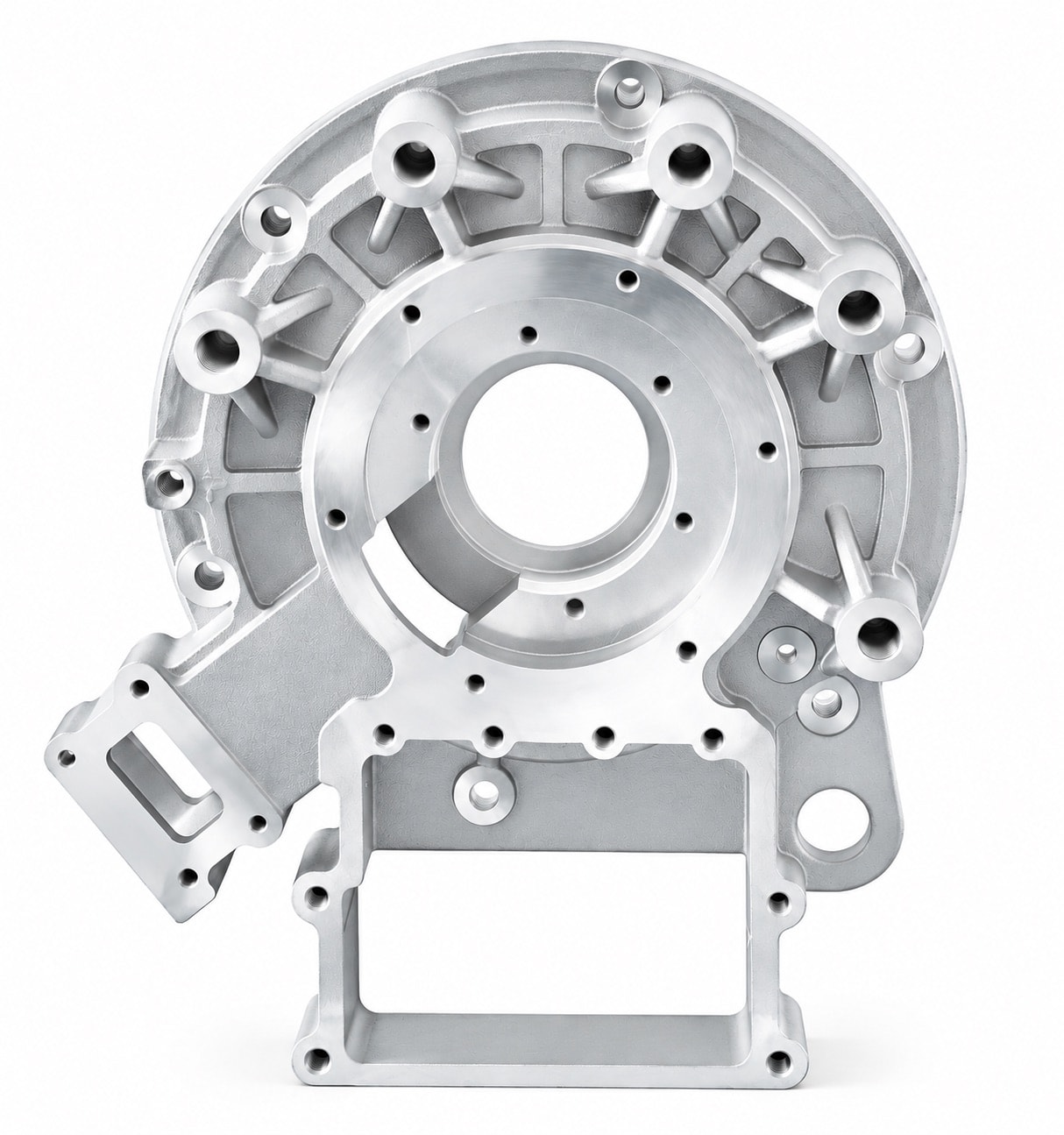
Die-Cast Aluminum Motor Rear End Cover: Shrinkage in the Mounting Bosses Eliminated, X-Ray to ASTM E505 Level 2
Heavy mounting bosses on this bearing-carrying end cover showed shrinkage on X-ray. Split, re-angled gates and local squeeze cleared it to ASTM E505 level 2; bearing bore coaxial within φ0.03 mm.
Part data
| Part name | Aluminum Motor Rear End Cover |
|---|---|
| Part type | Motor & gearbox housings |
| Application | Motor rear end cover (also the bearing housing) |
| Customer type | Electric-motor manufacturer |
| Alloy | ADC12 (JIS H5302) |
| Envelope | 约 290 × 270 × 70 mm |
| Part weight | 约 2.2 kg |
| Wall thickness | 4.0 – 5.0 mm(悬置孔凸台局部超过 15 mm) |
| Key requirements | Bearing-bore size and coaxiality, pilot and end-face squareness, sound metal in the mounting bosses and bearing seat |
| Machining | Bearing bore, pilot and end face finished in one setup; mounting holes and faces machined; drilled and tapped |
| Surface finish | Shot blasting |
| Delivered as | Machined part |
| In production since | 2025 |
* Figures shown are representative; actual values follow the drawing and DFM review.
Updated
Technical requirements
Bearing bore and pilot
The central bearing bore is machined to H7 and must be coaxial with the pilot within φ0.03 mm, with the end face square to the axis within 0.03 mm. The rear cover carries one end of the rotor, so a misplaced bearing bore makes the air gap between rotor and stator uneven.
Internal soundness
The mounting bosses on the back fix the motor to the machine and take its vibration. The bosses and the bearing seat are X-rayed and must meet ASTM E505 level 2, and no porosity or shrinkage may break out on a machined face.
Dimensional accuracy
The bolt circle and the mounting holes are held to φ0.1 mm true position; general dimensions follow GB/T 6414 casting tolerance grade DCTG 6.
Engineering challenges
The wrong fill sequence at the mounting bosses traps gas
In the first gating layout the metal entered the cavity from the centre. Flow simulation showed one mounting-boss area still unfilled after metal had closed in all round it, leaving the trapped gas nowhere to go. The boss area is complex and heavy and should fill first, pushing cold metal and gas on towards the overflows at the end of fill.
The heavy bosses cannot be fed
Re-gating fixed the fill sequence, yet X-rays of pilot parts still showed shrinkage concentrated at the centre of the mounting bosses. The bosses are more than three times as thick as the surrounding shell and freeze last; once the thinner walls around them have solidified and cut off the feed, the machine's intensification pressure no longer reaches the boss centre.
What we did
Split the gate in two and re-aim it (gating design)
We split the central gate into two branches and re-aimed them so the metal fills the heavy mounting-boss area first, then runs on to the bearing seat and the shell; several overflows at the end of fill collect the cold leading metal and any entrained gas. The fill sequence is confirmed by simulation and checked with short shots at trial.
Local squeeze on the mounting bosses (die design and casting)
Hydraulically driven squeeze pins were added at the bosses. They advance once the cavity is full and the metal is semi-solid, force-feeding the boss centre. The delay and hold times were set at trial and written into the process sheet. Every batch is sampled by X-ray, and the first parts were sectioned to confirm.
Bearing bore, pilot and end face finished in one setup (CNC machining)
The bearing bore, pilot and end face are finished in a single setup, with roughing and finishing separated and only a small allowance left for the finish cut. Coaxiality and squareness are checked on the CMM each batch, and every bearing bore is plug-gauged.
Results in stable production
In stable production the mounting bosses consistently meet ASTM E505 level 2 on X-ray, scrap from shrinkage fell from about 7% to under 1%, bearing-bore-to-pilot coaxiality holds within φ0.03 mm, and the key dimensions run at CPK ≥ 1.33.
Questions on this part
Which die castings benefit from local squeeze?+
Parts that are mostly moderate in section but very heavy in a few places — the mounting bosses on an end cover, the bearing seat in a housing, the lugs on a bracket. Those spots freeze last and the machine's intensification pressure cannot reach them, so a squeeze pin presses directly into the heavy section while the metal is semi-solid. It adds a cylinder and pins to the die, raising tool cost and maintenance, so the usual order is to core out and thin the section and rework the gating and overflows first, and squeeze only what still shrinks.
Can the bearing bore in a motor end cover be cast to size?+
No. A bearing bore normally needs an H7 fit and coaxiality in the 0.03 mm range, which as-cast tolerances cannot reach, so CNC finishing has to deliver it. What the casting must deliver is sound metal in the bearing seat and even stock — otherwise fine boring cuts through the skin and opens up the voids. At DFM we agree with the customer which dimensions the casting holds and which the machining holds.
Capabilities and further reading
Have a part like this?
Start with the cost estimator to see how the price is built, or upload a drawing for us to review — we reply within 24 hours.