CASE STUDIES · Smart Locks & Door Hardware
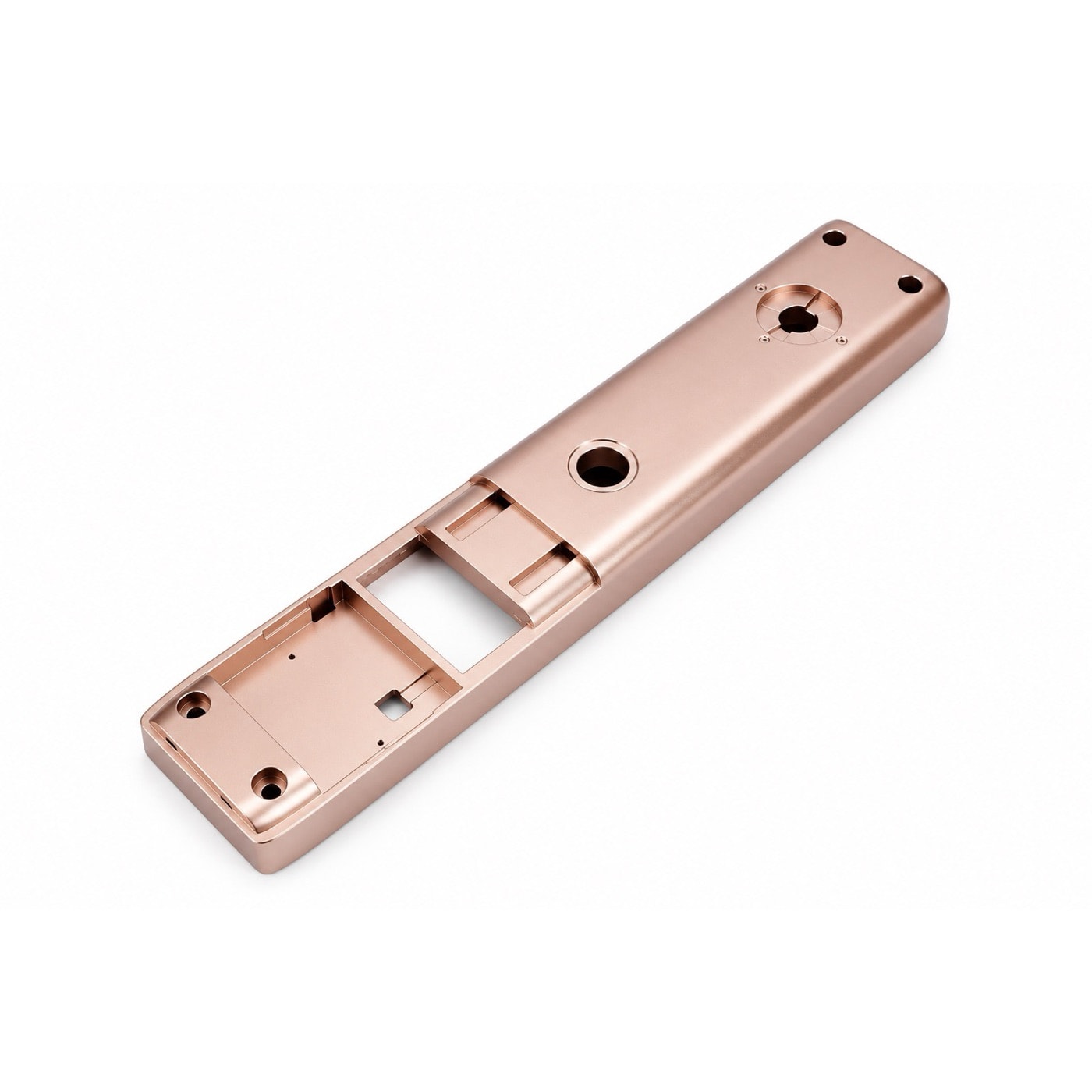
Die-Cast Zinc Smart Lock Panel with Rose-Gold PVD: Flat Within 0.15 mm, Batch Colour Difference ΔE ≤ 1.0
A 300 mm panel that warped after casting, under a PVD film too thin to hide sink marks. Cored bosses, zoned cooling and per-load colour checks give 0.15 mm flatness and ΔE ≤ 1.0.
Part data
| Part name | Zinc Alloy Smart Lock Panel with Rose-Gold PVD |
|---|---|
| Part type | Cosmetic parts |
| Application | Smart door lock front panel (cosmetic part, rose gold) |
| Customer type | Chinese smart-lock brand |
| Alloy | Zamak 3 / YZZnAl4A (GB/T 13818-2024) |
| Envelope | 约 300 × 70 × 24 mm |
| Part weight | 约 420 g |
| Wall thickness | 1.5 – 3.0 mm |
| Key requirements | Mating-face flatness ≤ 0.15 mm; Class-A faces free of sink marks, flow marks and polishing lines; batch colour difference ΔE ≤ 1.0; film adhesion |
| Machining | Deburring, cylinder-hole trimming, tapping |
| Surface finish | Polishing + base plating (partner shop, managed and warranted by us) + rose-gold PVD (in-house) |
| Delivered as | Finished part |
| In production since | 2025 |
* Figures shown are representative; actual values follow the drawing and DFM review.
Updated
Technical requirements
Geometric tolerance
Flatness of the face that mates with the door is specified at ≤ 0.15 mm. On a panel about 300 mm long, anything worse leaves a visible gap round the edge once it is on the door, and the gasket is compressed unevenly.
Appearance
The front and sides are Class-A faces and must be free of sink marks, flow marks, porosity and polishing lines, judged against the customer's boundary samples. A PVD film is usually under 1 μm thick and, unlike plating, levels nothing: whatever the substrate looks like, the finished part looks like.
Colour and film
The rose-gold colour is matched to a master panel signed off by the customer, with a batch-to-batch colour difference of ΔE ≤ 1.0; film adhesion must reach 4B or better on the ASTM D3359 cross-hatch test.
Engineering challenges
Two sections of different stiffness: the panel bows after casting
One end of the panel is open compartments for the battery and modules; the other is a solid curved section, so wall thickness and stiffness differ sharply between the two. Measured after resting, the first trial parts were up to 0.4 mm out of flat on the mating face. The open end cools and shrinks first, the solid end freezes later and shrinks more, and once the part is ejected that difference is released as a bow along its length.
Sink marks behind heavy sections, magnified by PVD
Shallow depressions appeared on the front, opposite the screw bosses and the cylinder-hole boss behind. Those spots are locally over 5 mm thick, freeze last, and their shrinkage pulls the skin inwards. On the raw casting the marks are nearly invisible and after polishing they show only under raking light — but once coated they become an obvious dark shadow.
Colour shifting from one coating load to the next
Panels of the same colour code looked lighter or darker when parts from different loads were laid side by side. The final PVD colour depends both on the substrate surface — how it was polished, how bright the base plating is — and on the coating parameters, and a drift in any of them moves the colour.
What we did
Core out heavy sections and even the walls (DFM review)
At DFM we had the customer core out the backs of the screw bosses and the cylinder-hole boss, keeping local walls to about 3 mm and replacing solid bosses with ribs. Flow simulation locates the hot spots, and first articles are polished and checked for sink marks under raking light.
Zone the cooling to the stiffness and eject evenly (die design and casting)
The die cooling is zoned between the open end and the solid end, with extra cooling on the solid end to narrow the shrinkage difference, and the ejectors are laid out to push evenly so a panel that is still warm is not bent on the way out. In production mating-face flatness is sampled every shift and re-measured after 24 h.
Polish to a reference sample, inspect every part before coating (pre-treatment)
Before coating, panels are polished and vibratory-finished, with the direction of the polishing lines and the brightness compared against a reference sample. Base plating is done by a partner shop; when the parts come back every one is inspected before it goes into the PVD chamber, and nothing marginal goes in.
Check every load against the master panel (PVD coating)
Every load is measured with a colorimeter against the customer's signed master panel, and any load over ΔE 1.0 is quarantined for review; film adhesion is sampled per load on the cross-hatch test.
Results in stable production
In stable production mating-face flatness holds within 0.15 mm, sink marks on Class-A faces fell from about 6% in the pilot run to under 0.5%, batch colour difference stays at ΔE ≤ 1.0, and first-pass yield through PVD holds above 95%.
Questions on this part
PVD or plating on a zinc panel — how do they differ in appearance?+
Copper-nickel plating is relatively thick — typically ten to several tens of microns — and fills fine polishing lines and pinholes. A PVD film is usually under 1 μm and hides almost nothing, but it offers a wide colour range (rose gold, gunmetal, champagne and more) and wears well. Decorative PVD on zinc normally goes over a plated base layer, so the substrate and that base layer decide the final look. We recommend fixing the colour, texture (bright, bead-blasted or brushed) and cosmetic grade at DFM.
How do you stop a long zinc panel warping after casting?+
Start with the design: big wall-thickness differences and a panel that is open at one end and solid at the other are the classic warpers. Coring out heavy sections and replacing solid bosses with ribs at DFM is the most effective fix; zoned die cooling and evenly placed ejectors narrow the shrinkage difference further. Zinc also shrinks slightly as it ages, so for flatness-critical panels it is worth stabilising the parts before they are measured for acceptance.
Related cases
Capabilities and further reading
Have a part like this?
Start with the cost estimator to see how the price is built, or upload a drawing for us to review — we reply within 24 hours.