CASE STUDIES · General Power & Garden Machinery
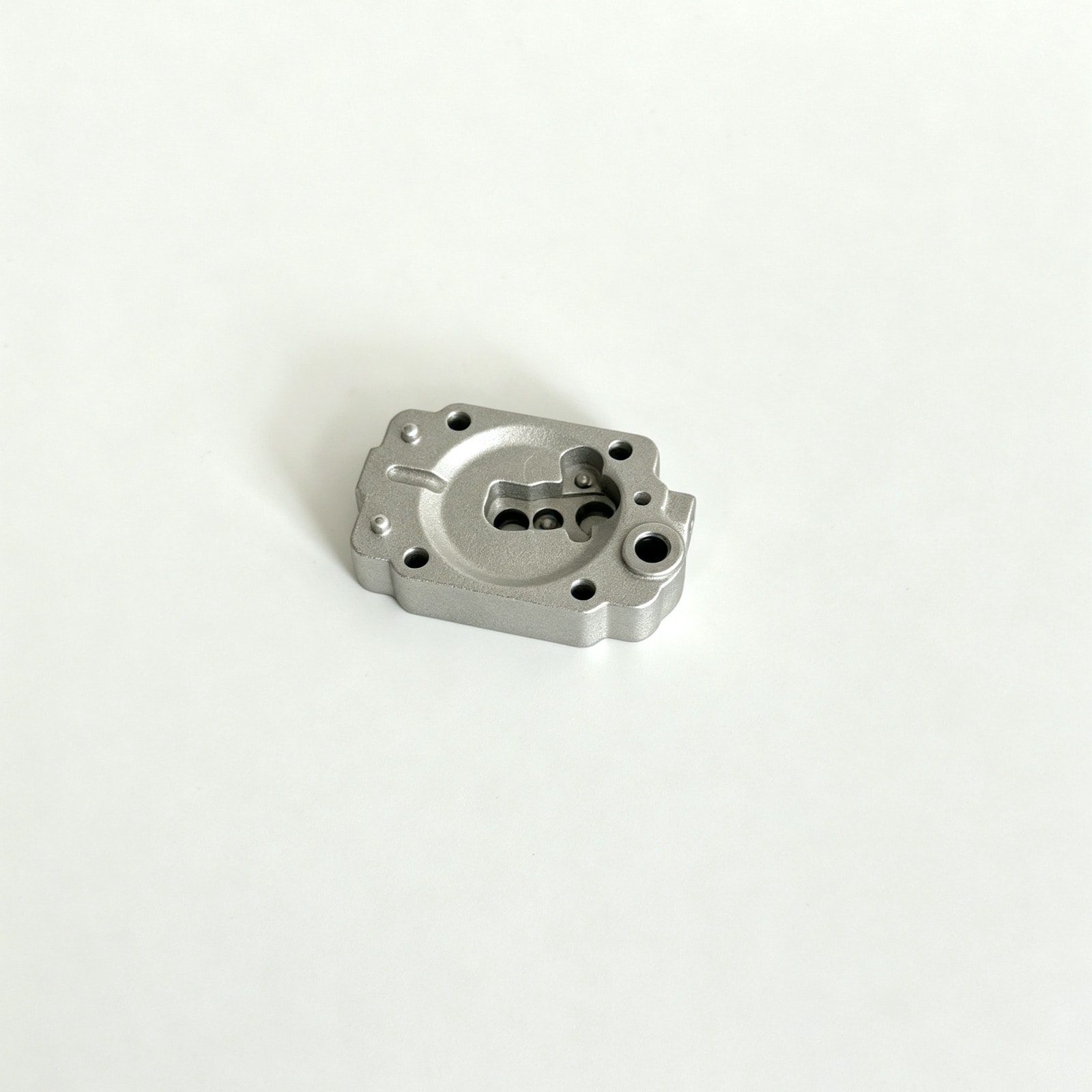
Die-Cast Diaphragm Carburetor Pump Cover: Multi-Cavity Tool, Sealing Face Flat to 0.03 mm
Far cavities cold-shut and hand deburring bent the 2 mm cover. Balanced runners and fixtured, pressure-controlled brushing now hold 0.03 mm flatness.
Part data
| Part name | Diaphragm Carburetor Pump Cover |
|---|---|
| Part type | Carburetor & fluid control |
| Application | Pump-chamber cover on GP-engine carburetors |
| Customer type | GP-engine OEMs |
| Alloy | ADC12 (JIS H5302) |
| Envelope | 约 60 × 45 × 15 mm |
| Part weight | 约 45 g |
| Wall thickness | 2.0 – 3.0 mm |
| Key requirements | Face flatness, tapped-hole position, burr-free |
| Machining | Face milled, drilled and tapped |
| Surface finish | Shot blasting |
| Delivered as | Machined part |
| In production since | 2012 |
* Figures shown are representative; actual values follow the drawing and DFM review.
Updated
Technical requirements
Geometric tolerances
The sealing face must be flat within 0.03 mm. The cover clamps the pump diaphragm, so its flatness decides whether the pump chamber leaks.
Dimensional accuracy
Tapped holes are located within φ0.15 mm true position so they line up with the carburetor body.
Cleanliness
No swarf or burrs may remain in the galleries or threads; every part is inspected and blown clean. Debris that reaches the carburetor blocks the jets.
Engineering challenges
Balancing fill across a multi-cavity layout
In a multi-cavity tool, the far cavities show flow marks and short fill on the sealing face. Unequal runner lengths mean the metal arrives at different times and temperatures; the far cavity fills with already-cooling metal and cold-shuts.
Distortion during deburring
Uneven hand pressure during deburring bends the thin cover and flatness goes out. A 2 mm part has little stiffness; a local force is enough to deform it plastically, and that does not spring back.
What we did
Runners balanced so every cavity fills together (die design)
With unequal runners, the far cavities fill with metal that has already cooled and show flow marks and cold shuts. We balance the runners by distance so the metal arrives together, confirmed by simulated fill times and short shots.
Deburring in a fixture with pressure-controlled brushing (post-processing)
A 2 mm part has little stiffness, and uneven hand pressure during deburring bends it permanently. We now deburr in a locating fixture with pressure-controlled brushing instead of by hand, and sample flatness afterwards.
Every tapped hole go-gauged (final inspection)
Every tapped hole is checked with a go gauge after tapping, and the pattern of any failures is logged and fed back to the tapping operation.
Results in stable production
In stable production sealing-face flatness is no more than 0.03 mm, more than 99.5% of threads pass, and parts from different cavities differ by no more than 0.03 mm.
Questions on this part
How many cavities make sense for a small part?+
It is a trade-off between spreading machine time and keeping the fill balanced. More cavities lower the per-part machine cost, but total runner length grows and the cavities fill less evenly, so the far ones cold-shut. In practice: size the clamping force from projected area first, then check whether the runners can be made roughly equal — four cavities that balance usually beat eight that barely fit. We quote the piece price at different cavity counts so the customer can weigh it up.
How do you deburr a small thin part without bending it?+
Keep local force off the part. Options: locate it in a fixture and brush with a controlled-pressure or nylon wheel; vibratory finishing with the right media, which suits small parts in volume; or, for precision sealing faces, take the burr off with a chamfer tool inside the milling cycle rather than by hand afterwards. For these covers we use a fixture with controlled-pressure brushing and sample flatness after deburring to confirm nothing moved.
Related cases
Capabilities and further reading
Have a part like this?
Start with the cost estimator to see how the price is built, or upload a drawing for us to review — we reply within 24 hours.