CASE STUDIES · Motorcycle & Two-Wheeler
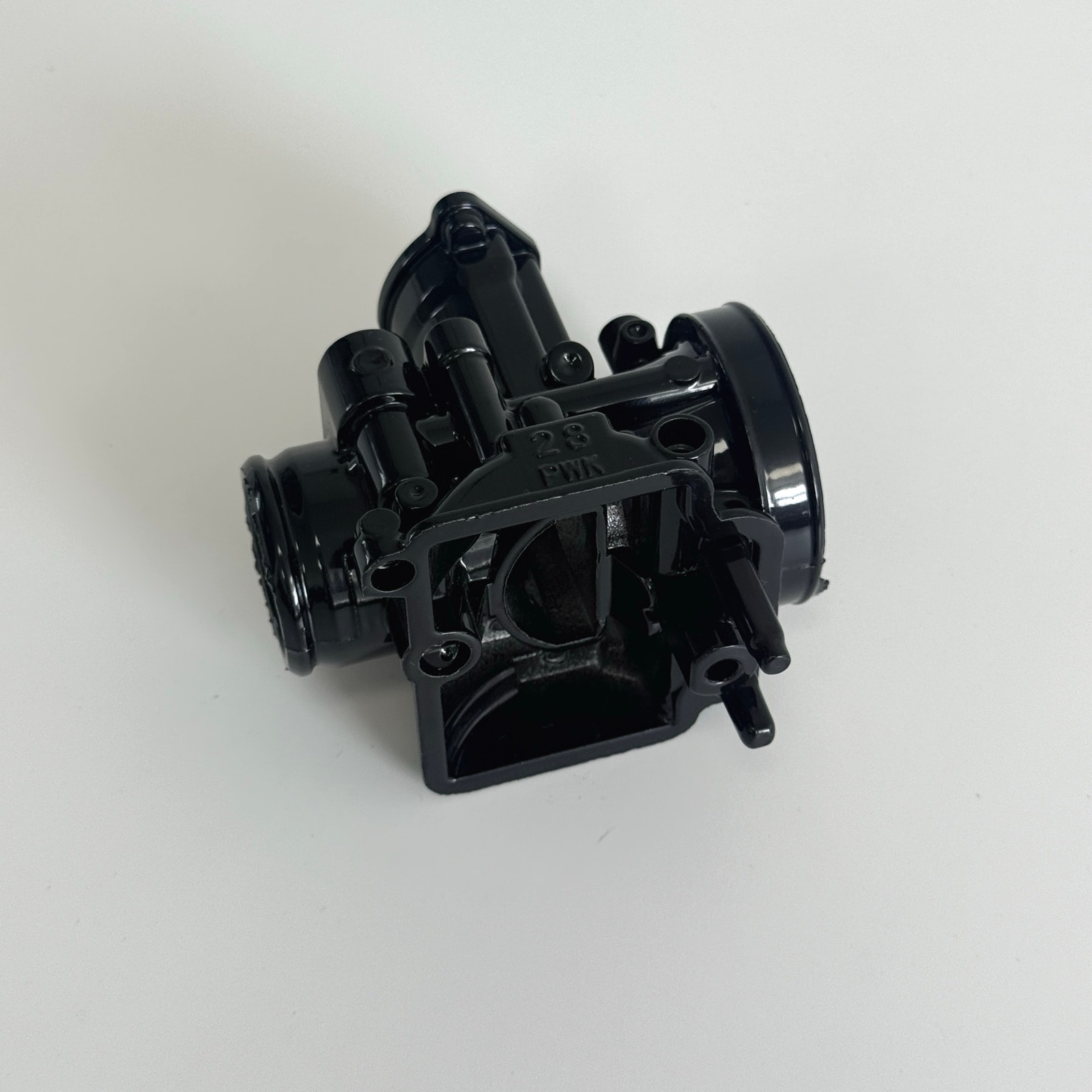
PWK28 Carburetor Body, Die-Cast and Black Coated: Cosmetic Rejects Held Under 1%
A gloss black coat magnifies every flow mark. Knit lines moved off the show faces, 100% pre-coat inspection and fixed blasting keep cosmetic rejects under 1%.
Part data
| Part name | PWK28 Carburetor Body |
|---|---|
| Part type | Carburetor & fluid control |
| Application | Aftermarket and racing motorcycle carburetors |
| Customer type | Aftermarket brands and export customers |
| Alloy | ADC12 (JIS H5302) |
| Envelope | 约 95 × 80 × 75 mm |
| Part weight | 约 300 g |
| Wall thickness | 2.5 – 4.0 mm |
| Key requirements | Visible faces free of flow marks and porosity, venturi size, coating adhesion |
| Machining | Venturi bored, throttle-shaft bores reamed, threads cut |
| Surface finish | Blasting + black coating |
| Delivered as | Finished part |
| In production since | 2023 |
* Figures shown are representative; actual values follow the drawing and DFM review.
Updated
Technical requirements
Appearance
Visible faces may show no flow marks, porosity or cold shuts, judged as Class A against the limit sample. The part sells into the aftermarket and is on show once fitted, so appearance matters as much as function.
Coating
The black coating must rate 4B or better on the cross-hatch adhesion test, at 20–40 μm film thickness.
Dimensional accuracy
The venturi is toleranced at ±0.05 mm and the throttle-shaft bores at ±0.02 mm; the shaft bores decide whether the throttle turns smoothly without binding.
Engineering challenges
Black coating magnifies casting marks
Shallow flow marks that are barely visible as-cast stand out clearly under the gloss coating. The coating covers evenly but does not fill; micro-relief is amplified by the gloss. Blasting normalises the base tone but cannot remove the depth of an existing flow mark.
Sub-surface porosity blisters after coating
Blisters appear locally after the coating bake. Sub-surface pores take up liquid during pre-treatment; heat during the bake expands it and lifts the coating — the same mechanism as blistering under zinc plating.
What we did
Gates and overflows placed so knit lines land off the show faces (die design)
A coating covers evenly but never fills, so flow marks have to be kept off the visible faces at the casting stage. We use flow simulation to find where the streams meet and move the gates and overflows until the knit lines fall on faces hidden once fitted; coated trial parts are checked as first articles.
Every part inspected before coating (in-process inspection)
A blank with a visible-face defect that reaches the coating line is scrapped with the coating cost on top. We inspect every part against the limit samples before coating and log where defects occur, feeding that back to the die and the process.
Fixed blasting parameters for a consistent base (finishing)
Blasting sets the tone and texture under the coating, so any drift becomes batch-to-batch colour variation. We fix the blasting parameters, treat each batch in one load, and sample colour every batch.
Results in stable production
In stable production cosmetic rejects after coating stay under 1%, coating adhesion rates 4B or better on the cross-hatch test, and colour variation between batches is held to ΔE ≤ 1.5.
Questions on this part
Blisters after coating — casting or coating?+
Same diagnosis as plating blisters: section the blister — a void or crack beneath it means sub-surface casting porosity; a flat substrate with the coating lifting as a sheet means the pre-treatment left oil behind or the part was not dried. On the casting side you attack entrapped gas (runner section, venting); on the coating side, pre-treatment and drying. Add a 100% visual gate before coating: catching suspect parts there costs far less than reworking them after.
Can weld lines be eliminated entirely on a cosmetic part?+
Not if the part has a hole or core — the metal splits and must rejoin somewhere. What you can do is decide where. During mould design we use flow simulation to locate the weld line, then re-aim the gate and add overflows so it lands on a non-cosmetic face or runs out into an overflow. That is design-stage work; once the tool is cut, machine settings rarely rescue it.
Related cases
Capabilities and further reading
Have a part like this?
Start with the cost estimator to see how the price is built, or upload a drawing for us to review — we reply within 24 hours.