CASE STUDIES · Motorcycle & Two-Wheeler
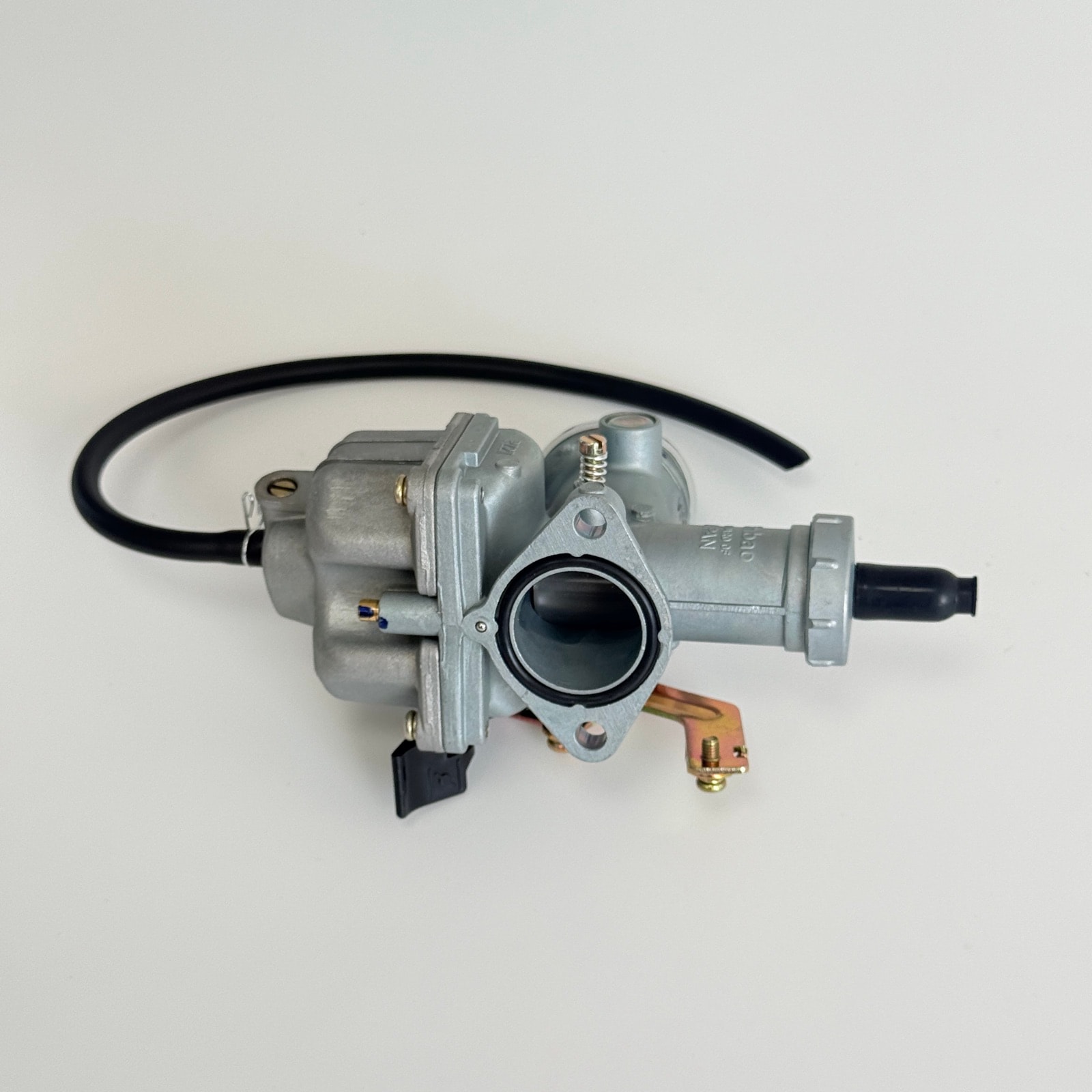
PZ27 Motorcycle Carburetor, Cast and Assembled In-House: Idle Flow Consistent Within ±2%
A 0.1 mm jet shift moves idle flow by over 5%. One-datum machining, flow-sorted jets and 100% bench testing hold ±2%, with over a million delivered.
Part data
| Part name | PZ27 Motorcycle Carburetor Assembly |
|---|---|
| Part type | Carburetor & fluid control |
| Application | 125–150 cc motorcycle engines |
| Customer type | Motorcycle OEM and aftermarket |
| Alloy | ADC12 (JIS H5302) |
| Envelope | 约 110 × 95 × 90 mm(总成) |
| Part weight | 约 420 g(总成) |
| Wall thickness | 2.5 – 4.0 mm |
| Key requirements | Jet true position, float-bowl face flatness, idle flow consistency |
| Machining | Venturi bored, jet holes drilled and reamed, sealing faces milled, threads cut |
| Surface finish | Shot blasting + passivation |
| Delivered as | Finished assembly, bought-out parts included |
| In production since | 2003 |
* Figures shown are representative; actual values follow the drawing and DFM review.
Updated
Technical requirements
Dimensional accuracy
The venturi is toleranced at ±0.05 mm and the jet bore at ±0.01 mm. Jet size meters the fuel directly, which makes it the tightest dimension on the carburetor.
Sealing
The float-bowl joint and the intake flange must be flat within 0.05 mm and hold 0.03 MPa for 30 s without leaking. An uneven joint face weeps fuel once fitted.
Function
Flow at idle and at wide-open throttle is accepted against the customer's flow curve, within ±2%.
Engineering challenges
Jet position drives the air-fuel ratio
A 0.1 mm shift in jet position moves idle flow by more than 5% and the engine will not hold a steady idle. The jet's position relative to the venturi sets where it senses depression; move it and the pressure differential — and therefore the fuel drawn — changes with it.
Float-bowl face distortion
When the joint face goes out of flat, the assembly weeps fuel in service. The thin-wall bowl distorts under residual casting stress and clamping load; machined before that stress is released, it passes at the machine and warps afterwards.
What we did
Jets and venturi machined from one datum (CNC machining)
The jet's position relative to the venturi sets where it senses depression, so any change of datum turns straight into a flow error. We machine the jets and venturi from the same datum and check every jet position on a vision measuring system.
Aged after roughing, sealing faces finished afterwards (machining process)
The float bowl is thin-walled; finished before the casting stress is released, it passes at the machine and warps later. We age the bodies after roughing and finish-mill the sealing faces only once the stress has relaxed, measuring flatness after finishing and again 24 h later.
Brass jets sorted by flow before assembly (incoming components)
Even ±0.01 mm on the bore is not enough to guarantee flow. We flow-sort every incoming brass jet, record its band, and build each carburetor from a single band.
100% flow-bench test on finished assemblies (final inspection)
Every assembly is tested at idle and wide-open flow on the bench; the curves are archived and any unit outside the tolerance is held.
Results in stable production
In stable production idle flow is held within ±2% from unit to unit and float-bowl weeping complaints stay below 0.1%. The carburetor has been in continuous production for years, with more than a million delivered.
Questions on this part
How is jet flow consistency controlled?+
Jet bores are held to about ±0.01 mm, and even that is not enough to guarantee flow, so the industry sorts jets by measured flow — typically in 1% bands — and builds one engine's worth from a single band. We flow-sort 100% of the brass jets, record the band, and re-test the finished assembly on the flow bench so idle and wide-open flow land within ±2% of the customer's curve.
How is a carburetor body leak tested?+
In two parts: the float bowl gets a pressure-decay test, commonly 0.03 MPa held for 30 s; the intake flange face and throttle-shaft bores get an overall seal test to rule out air being drawn in at idle. Where the shaft bore uses a seal or bush, we re-test after assembly, since pressing those in can change the seal.
Related cases
Capabilities and further reading
Have a part like this?
Start with the cost estimator to see how the price is built, or upload a drawing for us to review — we reply within 24 hours.