CASE STUDIES · Motorcycle & Two-Wheeler
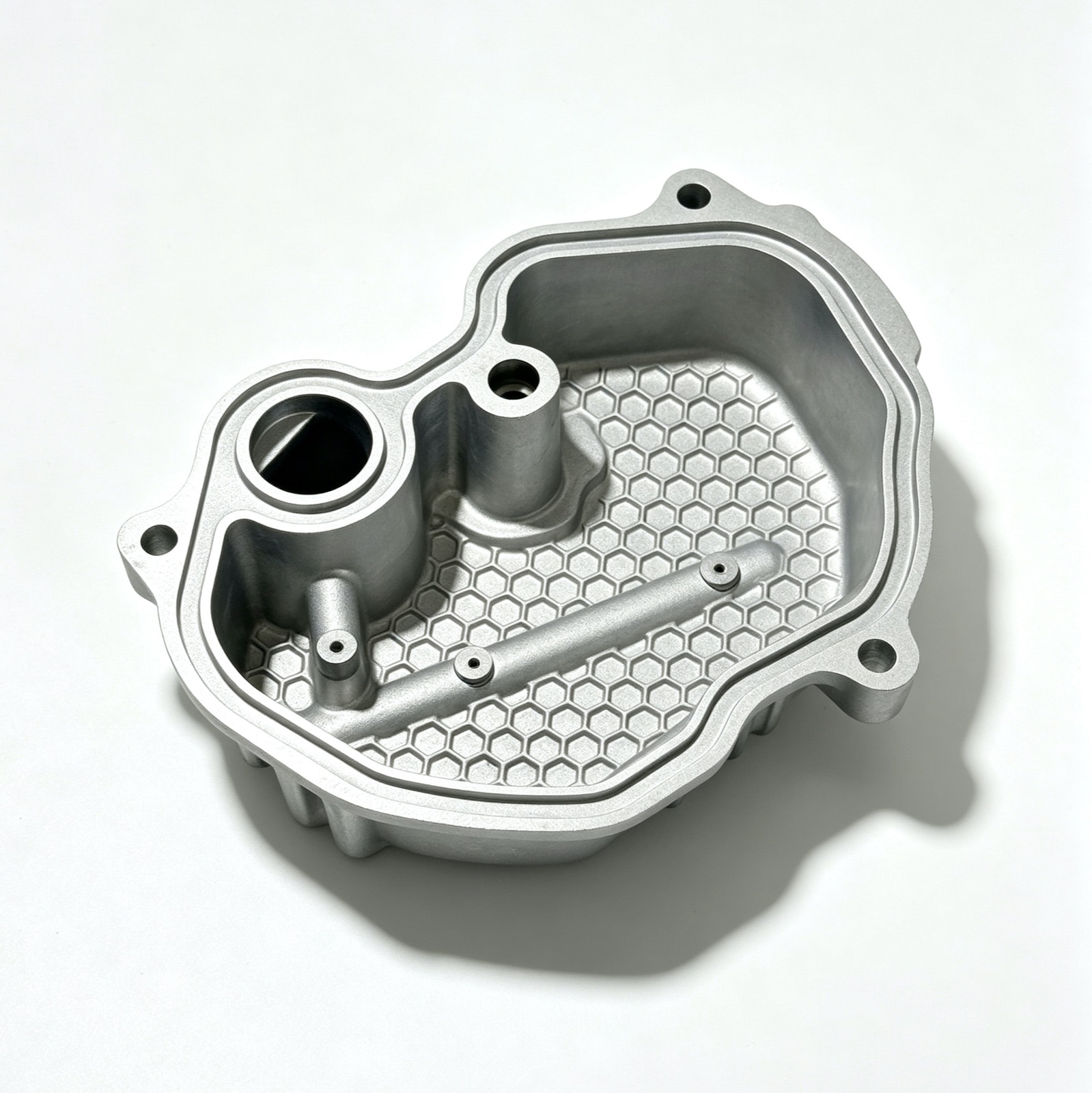
Die-Cast Motorcycle Cylinder Head Cover: Over 99% Pass X-Ray at the Honeycomb Rib Intersections
Where honeycomb ribs meet, the metal freezes last and shrinks. Ribs near 0.6× wall, thinned intersections and added venting now pass X-ray at over 99%.
Part data
| Part name | Motorcycle Cylinder Head Cover |
|---|---|
| Part type | Covers & structural parts |
| Application | Motorcycle engine cylinder head |
| Customer type | Chinese motorcycle OEM |
| Alloy | ADC12 (JIS H5302) |
| Envelope | 约 180 × 150 × 60 mm |
| Part weight | 约 460 g |
| Wall thickness | 2.5 – 4.0 mm(筋 2.0 mm) |
| Key requirements | Joint-face flatness, camshaft-bore true position, oil-gallery tightness |
| Machining | Joint face milled, camshaft bore bored, threads cut |
| Surface finish | Shot blasting |
| Delivered as | Machined part |
| In production since | 2022 |
* Figures shown are representative; actual values follow the drawing and DFM review.
Updated
Technical requirements
Geometric tolerances
The joint face must be flat within 0.06 mm and the camshaft bore located within φ0.1 mm; bore position decides whether the camshaft turns freely.
Internal soundness
No clustered shrinkage is allowed at the rib intersections or heavy sections, checked by X-ray sampling to ASTM E505 level 2.
Sealing
The oil gallery is leak tested at 0.05 MPa held for 20 s, with no leak allowed.
Engineering challenges
Shrinkage at rib intersections
X-ray shows clustered shrinkage where the honeycomb ribs meet. Where several ribs meet, the effective section is far thicker than its surroundings and becomes the last spot to freeze — with no feed path, the shrinkage shows up there as porosity.
Over-thick ribs sink the outer face
The outer face dimples opposite the ribs, still visible after blasting. Once a rib exceeds about 60–70% of the wall, heat concentrates at its root and the shrinking rib pulls the adjacent skin inwards.
What we did
Ribs held near 0.6× wall, intersections thinned and radiused (DFM review)
Once a rib exceeds about 60–70% of the wall, heat concentrates at its root, leaving shrinkage at the intersections and sink marks on the outer face. At DFM we worked with the customer to bring the ribs to about 0.6× wall and to thin and radius the intersections; flow simulation confirmed the hot spots, and the intersections are X-ray sampled.
Overflows and vents added near the hot spots (die design)
The intersections freeze last and need a feed path and venting. We added overflows and vents close to the hot spots and confirmed the result by sectioning trial parts and X-raying them.
Zoned core cooling to limit the rib-to-skin temperature gap (die design and production)
The bigger the difference in cooling between ribs and skin, the more the outer face sinks. We zone the core cooling, monitor die temperature in line during production, and check the outer face on the first article.
Results in stable production
In stable production more than 99% of parts pass X-ray inspection for shrinkage porosity, sink marks on the outer face stay below 0.5%, and more than 98% pass the oil-gallery leak test first time.
Questions on this part
How thick should a rib on a die casting be?+
Rule of thumb: rib thickness 0.5–0.7× the adjoining wall, height-to-width no more than 3:1, and a root radius of at least 0.5 mm. Too thin and it will not fill; too thick and it sinks the outer skin and creates a hot spot at the root. Where several ribs meet, thin them deliberately or core them out — otherwise the effective section dwarfs its surroundings and becomes a permanent home for shrinkage.
Does honeycomb ribbing actually help heat and noise?+
Yes, but not equally. The honeycomb mainly stiffens the panel, pushing its first natural frequency up so it radiates less noise under engine excitation. The added surface area does little for cooling, and the head cover is not a primary heat path anyway. So size the ribs for stiffness and castability, and treat any thermal gain as a bonus.
Related cases
Capabilities and further reading
Have a part like this?
Start with the cost estimator to see how the price is built, or upload a drawing for us to review — we reply within 24 hours.