CASE STUDIES · Motorcycle & Two-Wheeler
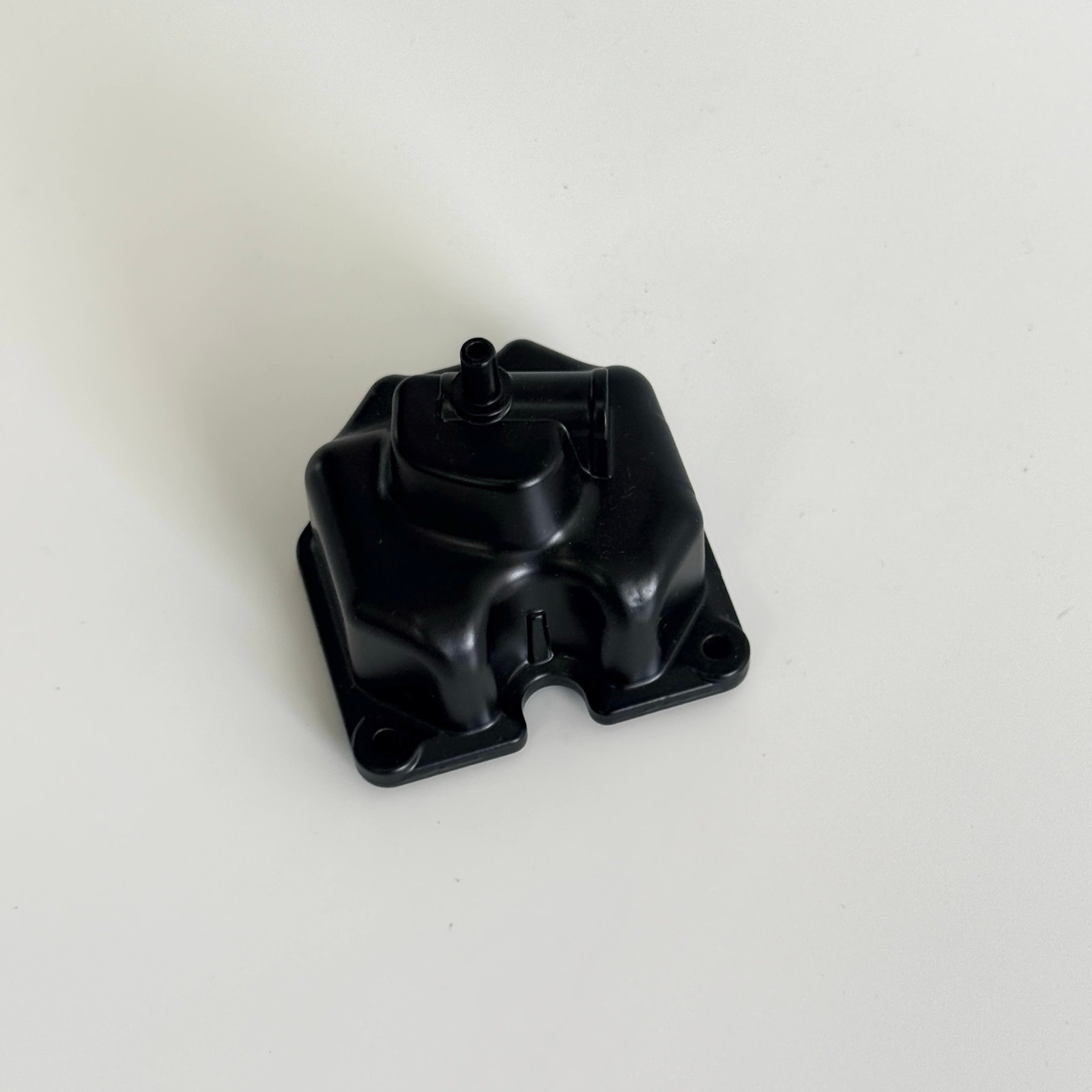
Die-Cast Motorcycle Valve Cover: 6 mm Sealing Land Flat to 0.05 mm, 99% First-Pass Leak Yield
A 6 mm land and a porous breather root caused sporadic leaks. A larger root radius, an overflow and single-pass milling now give 99% first-pass leak yield.
Part data
| Part name | Motorcycle Engine Valve Cover |
|---|---|
| Part type | Covers & structural parts |
| Application | Motorcycle engine valve chamber |
| Customer type | Motorcycle OEM |
| Alloy | ADC12 (JIS H5302) |
| Envelope | 约 95 × 80 × 40 mm |
| Part weight | 约 130 g |
| Wall thickness | 2.5 – 3.5 mm |
| Key requirements | Sealing-face flatness, breather tightness, coating appearance |
| Machining | Sealing face milled, mounting holes drilled |
| Surface finish | Blasting + black coating |
| Delivered as | Finished part |
| In production since | 2022 |
* Figures shown are representative; actual values follow the drawing and DFM review.
Updated
Technical requirements
Geometric tolerances
The sealing face must be flat within 0.05 mm. The land is only 6 mm wide, so even slight roll-off at an edge stops the gasket seating.
Sealing
The chamber and breather are leak tested together at 0.03 MPa held for 20 s, with no leak allowed.
Appearance
The outer face may show no sink marks and the black coating must be even, judged against the limit sample.
Engineering challenges
Hot spot at the breather-spigot root
X-ray shows shrinkage at the spigot root and the leak test fails intermittently. Where a slender boss meets the cover the effective section jumps, creating an isolated hot spot with no feed path.
Flatness of a narrow sealing land
The land is only 6 mm wide and edges roll over in milling, so the gasket does not seat evenly. Tool deflection at entry and exit leaves a slight roll-off; on a wide face it is irrelevant, on a 6 mm land it decides whether the gasket seals.
What we did
Larger breather-root radius with an overflow nearby (DFM and die design)
Where the slender breather meets the cover the section jumps, leaving an isolated hot spot with no feed path. At DFM we opened up the root radius and added an overflow nearby to feed it; the root is X-ray sampled and every cover is leak tested.
Sealing face formed in one die half and milled in a single pass (die design and CNC)
When milling a narrow land, tool deflection at entry and exit leaves slight roll-off at the edges. We form the whole sealing face in one die half and mill it in a single pass with no step-over; flatness is checked on every part and contact is blue-checked.
Every part inspected before coating (in-process inspection)
Sink marks only become more visible under a black coat, so every part is checked against the limit sample before coating and any with sink marks is kept off the line.
Results in stable production
In stable production 99% of covers pass the leak test first time, coating cosmetic rejects are below 1%, and sealing-face flatness is no more than 0.05 mm.
Questions on this part
How do you fix shrinkage at the root of a boss?+
The cause is a step change in effective section creating an isolated hot spot. Three directions: design the root as a gradual transition with a generous radius and core the boss out if you can; add an overflow near the hot spot to create a feed path, or apply local squeeze; and cool that area harder to shrink the solidification gap. Fix the design first — the mould and process can only do so much afterwards.
How do you get a narrow sealing land to seal?+
Three things: mill the land in one continuous pass so there is no step where cuts meet; arrange entry and exit off the land so tool deflection rolls the edge somewhere harmless; and accept it on a blue-check of contact area rather than a flatness number alone — on a narrow land, 0.03 mm of roll-off is enough to leave the gasket unsupported.
Related cases
Capabilities and further reading
Have a part like this?
Start with the cost estimator to see how the price is built, or upload a drawing for us to review — we reply within 24 hours.