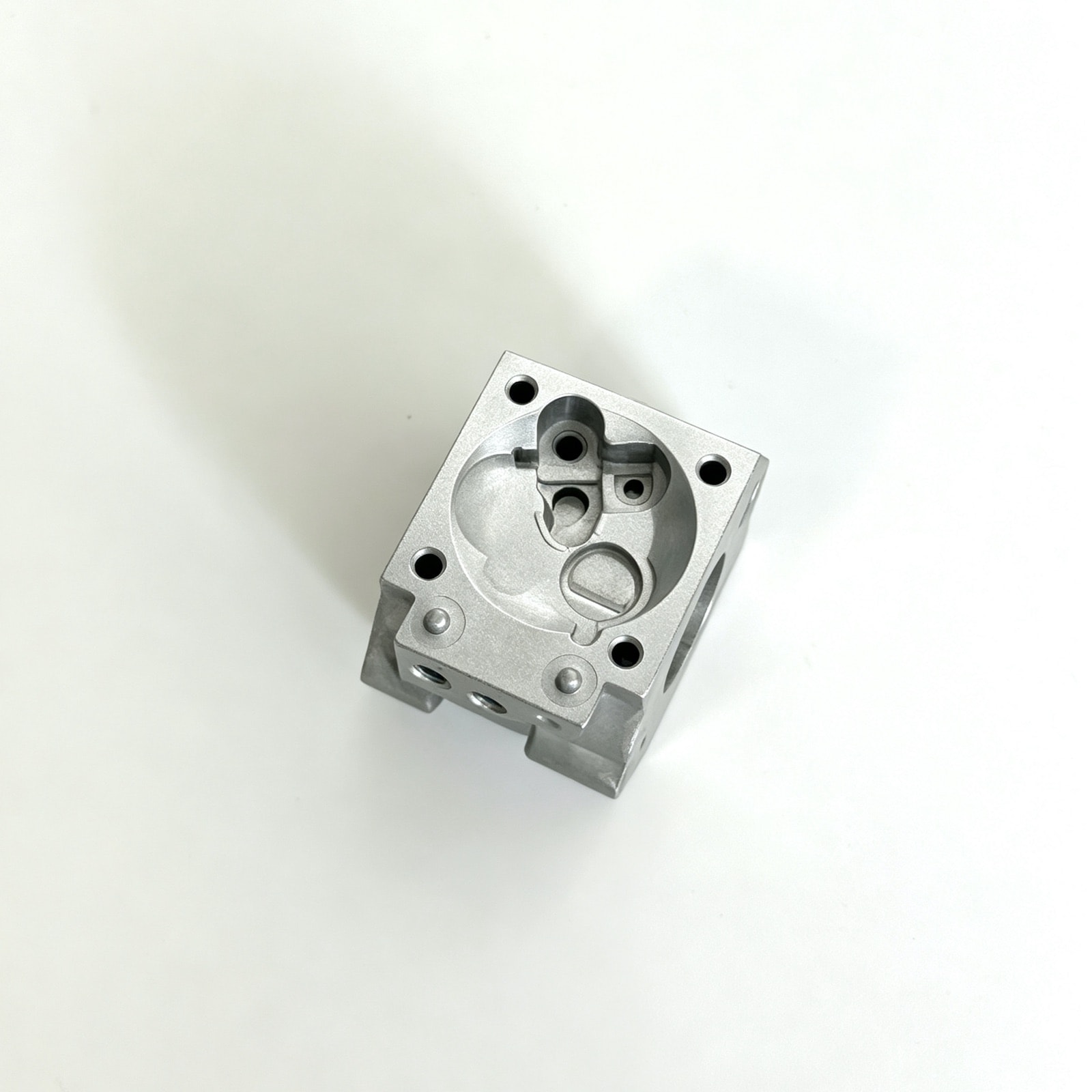
CASE STUDIES · General Power & Garden Machinery
Die-Cast Small Engine Carburetor Body: Sealed Gallery Intersections, Over 98% First-Pass Leak Yield
Drilled galleries opened casting porosity where they crossed, and plugs caused new leaks. Layout changes and 100% re-testing after plugging now pass over 98%.
Part data
| Part name | Small Engine Carburetor Body |
|---|---|
| Part type | Carburetor & fluid control |
| Application | Small petrol engine carburetors |
| Customer type | GP-engine OEMs |
| Alloy | ADC12 (JIS H5302) |
| Envelope | 约 70 × 55 × 50 mm |
| Part weight | 约 170 g |
| Wall thickness | 3.0 – 5.0 mm |
| Key requirements | Gallery tightness, jet true position, venturi size |
| Machining | Venturi bored, galleries drilled, jets reamed, plug bores machined |
| Surface finish | Shot blasting |
| Delivered as | Machined part |
| In production since | 2010 |
* Figures shown are representative; actual values follow the drawing and DFM review.
Updated
Technical requirements
Sealing
The complete gallery system, plugs included, is leak tested at 0.05 MPa held for 30 s, with no leak allowed.
Dimensional accuracy
Jets are located within φ0.1 mm true position with bores toleranced at ±0.01 mm; together they set how much fuel is drawn.
Internal soundness
No through-porosity is allowed in the gallery walls, checked by X-ray sampling and a 100% leak test on finished bodies.
Engineering challenges
Leaks where drilled galleries cross
The leak test fails at gallery intersections, weeping along the line where they meet. The wall is thinnest where two bores intersect; if the casting has porosity there, drilling opens it into a through path.
Leaks appearing after the plugs go in
The body passes before plugging and fails after. Press-fit stress can open micro-porosity that was previously closed, or the plug itself may not be sealing against the bore.
What we did
Gallery layout reviewed at DFM so intersections avoid thin walls and hot spots (DFM review)
The wall is thinnest where two bores intersect, and if that point falls in a porous zone, drilling opens a through path. At DFM we overlay the simulated porosity risk on the gallery positions and adjust the layout so intersections stay clear of thin walls and hot spots.
High-pressure casting with reworked gating and venting to cut entrapped gas around the galleries (casting process)
Around the galleries we reworked gating and venting to reduce the gas trapped in the cavity and cut porosity in the gallery walls at source; parts are X-ray sampled and every finished body is leak tested.
Leak tested before and after the plugs are pressed (final inspection)
Press-fit stress can open micro-porosity that was previously closed, or the plug may not seal against its bore. We leak test before and after pressing, which catches the second leak and shows whether the casting or the pressing caused it.
Results in stable production
In stable production more than 98% pass the leak test first time, jet true position holds within φ0.1 mm, and key dimensions run at CPK ≥ 1.33 from batch to batch.
Questions on this part
A leak where galleries cross — casting or machining?+
Usually casting porosity that machining opened up. Section a failed part at the intersection: a void or spongy area points to casting; clean bore walls with the leak tracking a thread or plug face point to machining or assembly. The fixes differ — the first needs gating and venting work, the second a change in drilling sequence or plug interference. We leak-test before and after plugging precisely so the two can be told apart.
What are MOQ and sampling lead times on a part like this?+
No MOQ for samples — we can produce them from a simplified or modified tool first. A production tool normally takes about 30–45 days to build and the T1 trial 3–5 days, and a pilot run can follow sample approval. Production starts at 500 pcs; the smaller the batch, the more set-up and changeover cost each part carries, and the piece price rises accordingly.
Related cases
Capabilities and further reading
Have a part like this?
Start with the cost estimator to see how the price is built, or upload a drawing for us to review — we reply within 24 hours.