CASE STUDIES · General Power & Garden Machinery
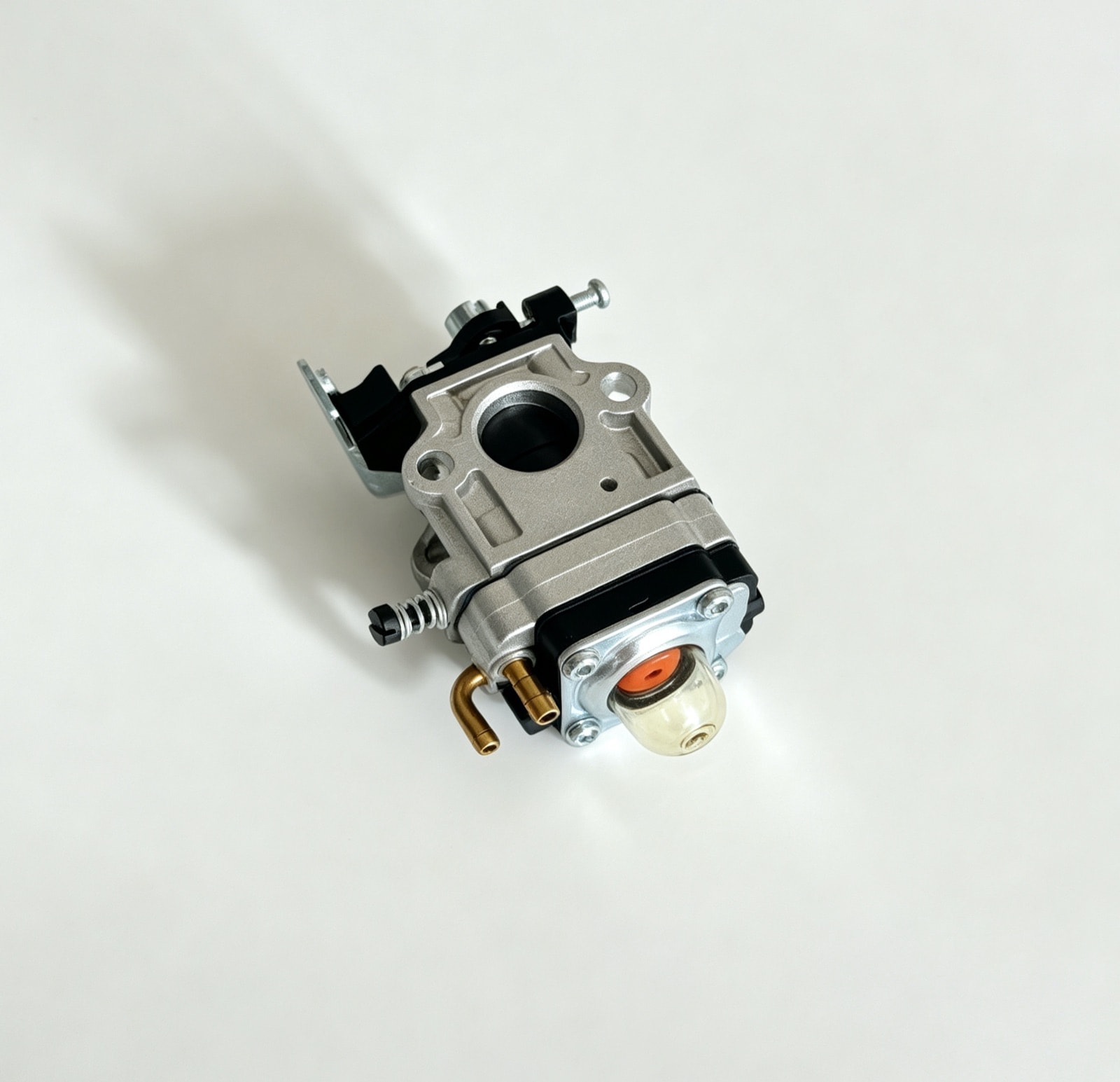
Die-Cast Diaphragm Carburetor for Brush Cutters: Diaphragm Faces Flat to 0.03 mm, Starting Complaints Under 0.5%
Diaphragm faces over 0.05 mm out of flat made engines stall hot. One-setup milling, low-stress holding and 100% leak and flow tests now hold 0.03 mm.
Part data
| Part name | Diaphragm Carburetor for Brush Cutters and Chainsaws |
|---|---|
| Part type | Carburetor & fluid control |
| Application | Brushcutters, chainsaws and other small petrol engines |
| Customer type | GP-engine OEMs and export customers |
| Alloy | ADC12 (JIS H5302) |
| Envelope | 约 75 × 65 × 55 mm(总成) |
| Part weight | 约 180 g(总成) |
| Wall thickness | 2.0 – 3.5 mm |
| Key requirements | Diaphragm-face flatness, jet bore, fuel delivery at any attitude |
| Machining | Diaphragm faces milled, venturi bored, jets drilled and reamed, threads cut |
| Surface finish | Shot blasting + passivation |
| Delivered as | Finished assembly, diaphragms/springs/components included |
| In production since | 2005 |
* Figures shown are representative; actual values follow the drawing and DFM review.
Updated
Technical requirements
Geometric tolerances
The pump and metering diaphragm faces must be flat within 0.03 mm; a diaphragm seals by its own elasticity and cannot make up for an uneven face.
Dimensional accuracy
The jet bore is toleranced at ±0.01 mm and the venturi at ±0.05 mm.
Function
The pump chamber is leak tested at 0.05 MPa held for 30 s, and fuel delivery is accepted within ±2% of the customer's curve. Brush cutters and chainsaws work at every angle, so the carburetor has to feed steadily in any attitude.
Engineering challenges
The diaphragm faces need exceptional flatness
Beyond 0.05 mm the diaphragm stops sealing, pumping falls off and the engine dies once hot. The diaphragm seals by its own elasticity and cannot conform to an uneven surface, so any waviness becomes a leak path.
Distortion in a small thin-wall body
Clamp, mill the diaphragm face, release — and the flatness has gone. A 2 mm wall deflects elastically under clamping load, and the machined face follows it back when released.
What we did
Both diaphragm faces milled in one setup (CNC machining)
Milling the two diaphragm faces separately brings in datum-transfer error. We mill both in one setup, check flatness on every body and blue-check the contact area.
Vacuum chuck or wide soft jaws for low-stress holding (fixture design)
A 2 mm wall deflects under clamping load and the machined face follows it back on release. A vacuum chuck or wide soft jaws spread the load, and flatness is measured both clamped and released.
Brass jets sorted by flow before assembly (incoming components)
Incoming brass jets are sorted into flow bands and recorded, and each carburetor is built from a single band so flow stays consistent.
100% leak and flow test on finished assemblies (final inspection)
Every assembly is leak and flow tested, with the data archived and traceable.
Results in stable production
In stable production diaphragm-face flatness is no more than 0.03 mm and starting complaints are below 0.5%. It has been in continuous production for years and is exported to several markets.
Questions on this part
Why does a diaphragm carburetor need flatter faces than a float type?+
A float carburetor uses gravity to set the fuel level and the joint face mostly just retains fuel. A diaphragm type pumps by flexing against a pressure difference, and that difference only builds if the diaphragm contacts the face all the way round. The diaphragm is thin and compliant with no ability to bridge waviness, so these faces are typically held to 0.03 mm against 0.05 mm for a float bowl.
What certification issues come up exporting GP-engine carburetors?+
Emissions and materials. For emissions, GP engines going to the US or EU have to meet EPA Phase 3 or EU Stage V for evaporative and exhaust limits, and jet configuration and sealing feed directly into that. For materials, you will need RoHS/REACH reports, with lead content watched closely — some markets cap lead in brass components. We supply material certificates and third-party reports with the goods; we confirm exactly which at quotation.
Related cases
Capabilities and further reading
Have a part like this?
Start with the cost estimator to see how the price is built, or upload a drawing for us to review — we reply within 24 hours.