CASE STUDIES · Pumps, Valves & Fluid Components
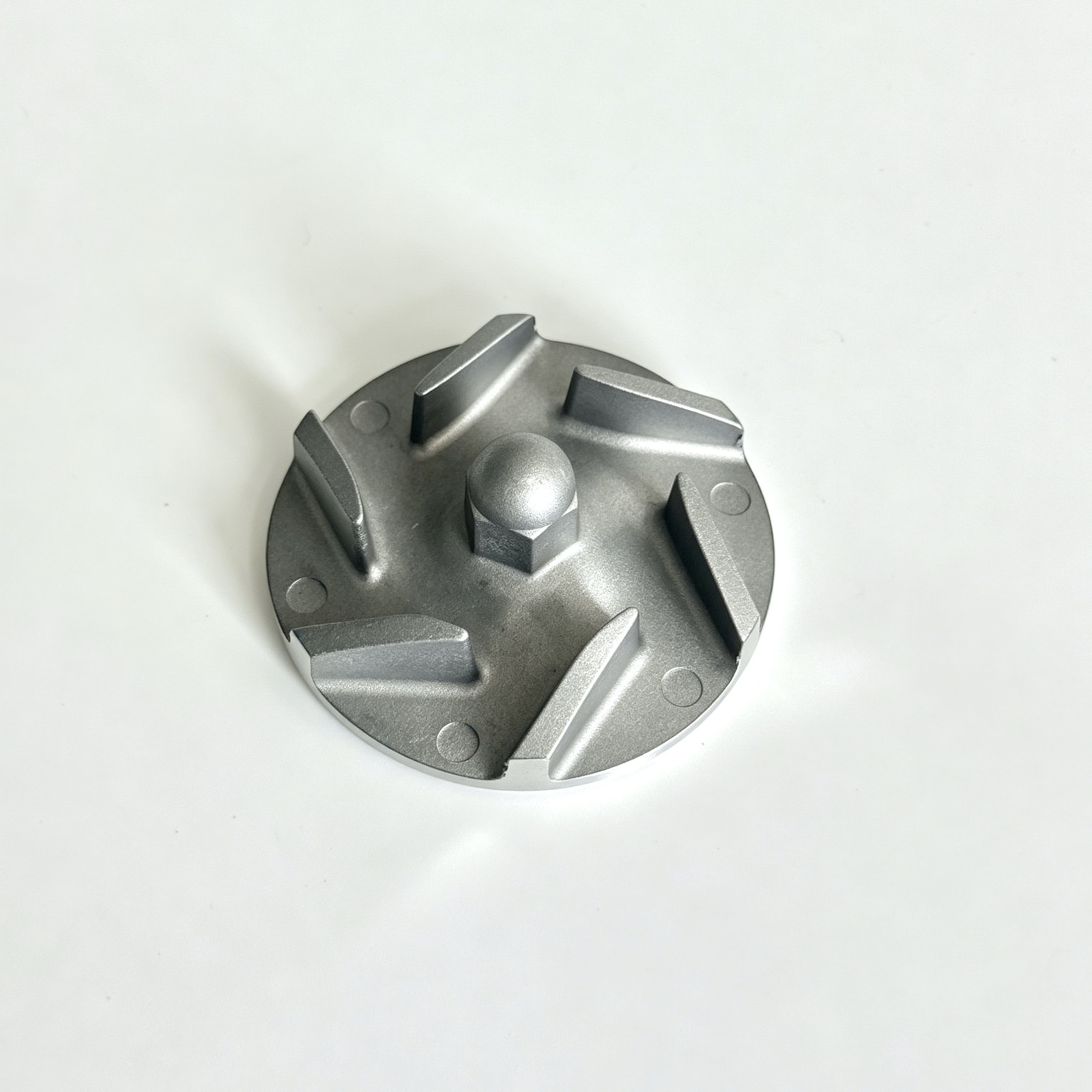
Die-Cast Engine Water Pump Impeller: Residual Imbalance ≤ 1 g·mm, Blade Walls Within 0.15 mm
Core shift left one side of the impeller thick and the other thin. Double-guided cores and symmetric gates hold blades within 0.15 mm and imbalance to 1 g·mm.
Part data
| Part name | Engine Water Pump Impeller |
|---|---|
| Part type | Rotating & drive parts |
| Application | Engine cooling pump |
| Customer type | OEM and aftermarket |
| Alloy | ADC12 (JIS H5302) |
| Envelope | 约 Ø70 × 30 mm |
| Part weight | 约 85 g |
| Wall thickness | 2.0 – 3.5 mm |
| Key requirements | Dynamic balance, blade-wall uniformity, bore fit |
| Machining | Centre bore, end faces turned |
| Surface finish | Shot blasting |
| Delivered as | Machined part |
| In production since | 2022 |
* Figures shown are representative; actual values follow the drawing and DFM review.
Updated
Technical requirements
Balance
Residual imbalance must not exceed 1 g·mm. The centrifugal force it produces grows with the square of speed and turns straight into vibration that shortens the pump bearing's life.
Dimensional accuracy
The centre bore is toleranced at ±0.02 mm and face runout held to 0.05 mm, so the impeller runs true once fitted to the shaft.
Consistency
Blade walls on one impeller may differ by no more than 0.15 mm; the blades carry most of the mass, so uneven walls are where imbalance comes from.
Engineering challenges
Uneven blade walls create imbalance
Once blade walls differ by more than 0.2 mm the part fails the balance check. The mass is distributed around the axis, so any circumferential asymmetry produces centrifugal imbalance — and it grows with the square of speed.
Core shift producing circumferential wall variation
One side of the impeller runs thick and the opposite side thin — a systematic bias, not random scatter. The core shifts under filling pressure, always in the same direction, giving a systematic circumferential difference that machining cannot correct.
What we did
Core guided from both ends for repeatable positioning (die design)
Under filling pressure the core shifts, always the same way, leaving one side thick and the other thin — a systematic difference that machining cannot correct. We guide the core from both ends and control how precisely it returns each cycle; a first article is sectioned and every blade measured.
Symmetric gates so the core is not pushed from one side (die design)
Metal driving at the core from one side pushes it towards the other. We place the gates symmetrically so the loads on the core balance out, checked by simulating the core loading and comparing blade walls on trial parts.
Balance testing to the customer's requirement (final inspection)
On this project impellers are balance-tested to the customer's requirement and none out of limit is released; the imbalance data is archived and trended so any sign of core shift is caught and the die adjusted.
Results in stable production
In stable production residual imbalance is no more than 1 g·mm, blade wall thickness varies by no more than 0.15 mm, and more than 98% pass balancing first time.
Questions on this part
Do cast impellers need material removed to balance them?+
Small pump impellers usually do not. With stable core location and symmetric gating, as-cast imbalance stays within 1 g·mm, which covers normal running speeds. Balancing cuts show up in two situations: very high-speed impellers, or parts where core shift has already produced a systematic wall difference — and that second one belongs back at the mould, since grinding it out adds an operation while hiding the real problem.
How do you actually measure blade-wall variation?+
In production we use an ultrasonic gauge at fixed points — fast, but only where the probe can reach. For first articles and after any process change we section the part, cutting it circumferentially to measure every blade, which is the only way to see which direction a systematic bias runs. So: section the first article, ultrasonic-sample in production, and record readings by angular position — a bias that always points the same way tells you it is core shift rather than random scatter.
Related cases
Capabilities and further reading
Have a part like this?
Start with the cost estimator to see how the price is built, or upload a drawing for us to review — we reply within 24 hours.