CASE STUDIES · Motorcycle & Two-Wheeler
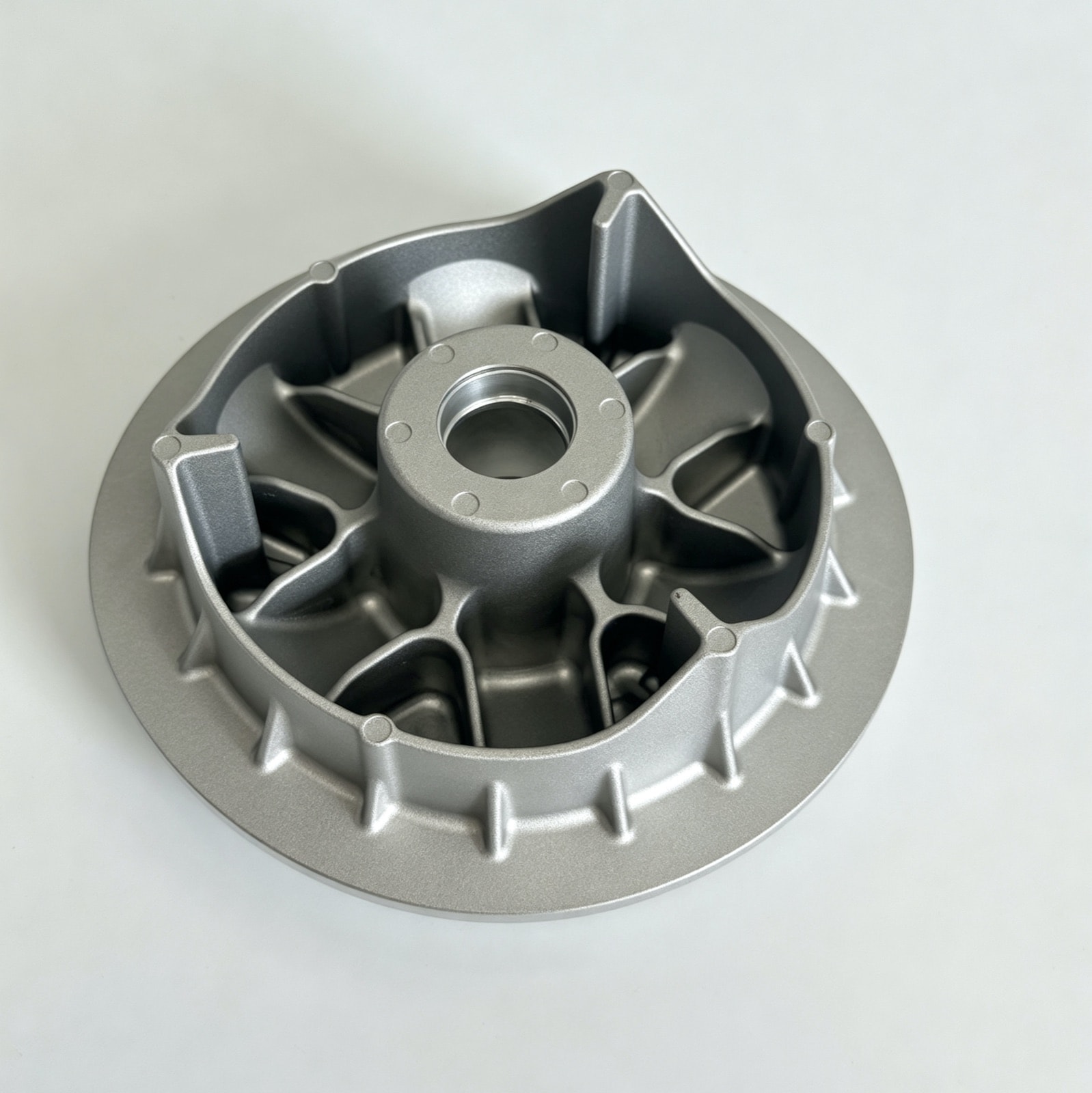
Die-Cast Motorcycle Clutch Pressure Plate: Over 99% Complete Fills on 2 mm Fins, 0.05 mm Face Runout
2 mm fins short-filled at the tips and warped the face. Hotter fin cavities, tip vents and flow-length control now fill over 99%, with runout within 0.05 mm.
Part data
| Part name | Motorcycle Clutch Pressure Plate |
|---|---|
| Part type | Rotating & drive parts |
| Application | Pressure plate in a motorcycle clutch assembly |
| Customer type | Motorcycle OEM and aftermarket |
| Alloy | ADC12 (JIS H5302) |
| Envelope | 约 Ø130 × 30 mm |
| Part weight | 约 260 g |
| Wall thickness | 3.0 – 5.0 mm(筋 2.0 mm) |
| Key requirements | Face runout, spring-seat position, fin completeness |
| Machining | Faces turned, spring seats machined, centre bore |
| Surface finish | Shot blasting |
| Delivered as | Machined part |
| In production since | 2023 |
* Figures shown are representative; actual values follow the drawing and DFM review.
Updated
Technical requirements
Geometric tolerances
Friction-face runout and parallelism are both held to 0.05 mm. A face that runs out wobbles as the clutch disengages and affects how cleanly it releases.
Completeness
No fin may be short-filled or broken, and every plate is checked visually against a master. A short fin cools less and throws the plate out of balance.
Dimensional accuracy
The spring-seat holes are located within φ0.15 mm true position so that every pressure spring carries an even share of the load.
Engineering challenges
Fin tips not filling
Fins furthest from the gate come out short, with the tips rounded off. ADC12 can only run so far at a 2 mm section before the front cools and stops flowing; if the tip is not vented, back-pressure blocks the fill as well.
Uneven die temperature around the fins
After a run, dimensions around the fins drift and face runout gets worse. The fin slots present far more surface than the body and lose heat faster; the resulting shrinkage differential shows up as a warped face.
What we did
Hotter fin cavities with vents and overflows at the tips (die design and casting)
ADC12 only runs so far at a 2 mm section before the front cools and stops at the fin tips, and an unvented tip adds back-pressure on top. We run the fin cavities hotter and add vents and overflows at the tips; the first article and every shift are checked visually against the master.
Fin flow-length ratio held, with local thickening at the root where needed (DFM review)
A fin that is too long for its thickness will not fill whatever the process does. At DFM we hold the flow-length ratio and, where needed, thicken the root locally as a flow leader; simulation confirms the end of fill and short shots verify it.
Stress relieved before the faces are finish-turned in separate passes (CNC machining)
The fins lose heat faster than the body, and the shrinkage difference stays in the part as a warped face. We relieve stress before finishing, turn the faces in separate roughing and finishing passes, and check runout on every plate.
Results in stable production
In stable production more than 99% of plates fill the fins completely, face runout holds within 0.05 mm, and dimensions vary by no more than 0.03 mm between batches.
Questions on this part
How thin can a cast cooling fin go?+
Aluminum fins are routinely 1.5–2.5 mm and can be pushed to about 1.2 mm, provided three things hold: a height-to-thickness ratio no worse than about 6:1, at least 1.5° draft per side, and real venting at the tip. Pitch matters too — closer than about twice the fin thickness and the die ribs become fragile and run hot, so we keep pitch above that. Beyond those limits, machined or extruded fins are the better answer.
Is raising shot velocity the only fix for short-filled fins?+
No — and pushing velocity often backfires, because too fast means more entrapped gas and more die erosion. Work in this order: confirm die temperature (thin-fin parts usually want 200–240 ℃), check the venting at the tips, then look at whether the flow-length ratio is over the limit and whether the fin root needs thickening as a flow leader. Velocity is the last dial, not the first; reach for it first and you usually buy porosity rather than fill.
Capabilities and further reading
Have a part like this?
Start with the cost estimator to see how the price is built, or upload a drawing for us to review — we reply within 24 hours.