CASE STUDIES · Pumps, Valves & Fluid Components
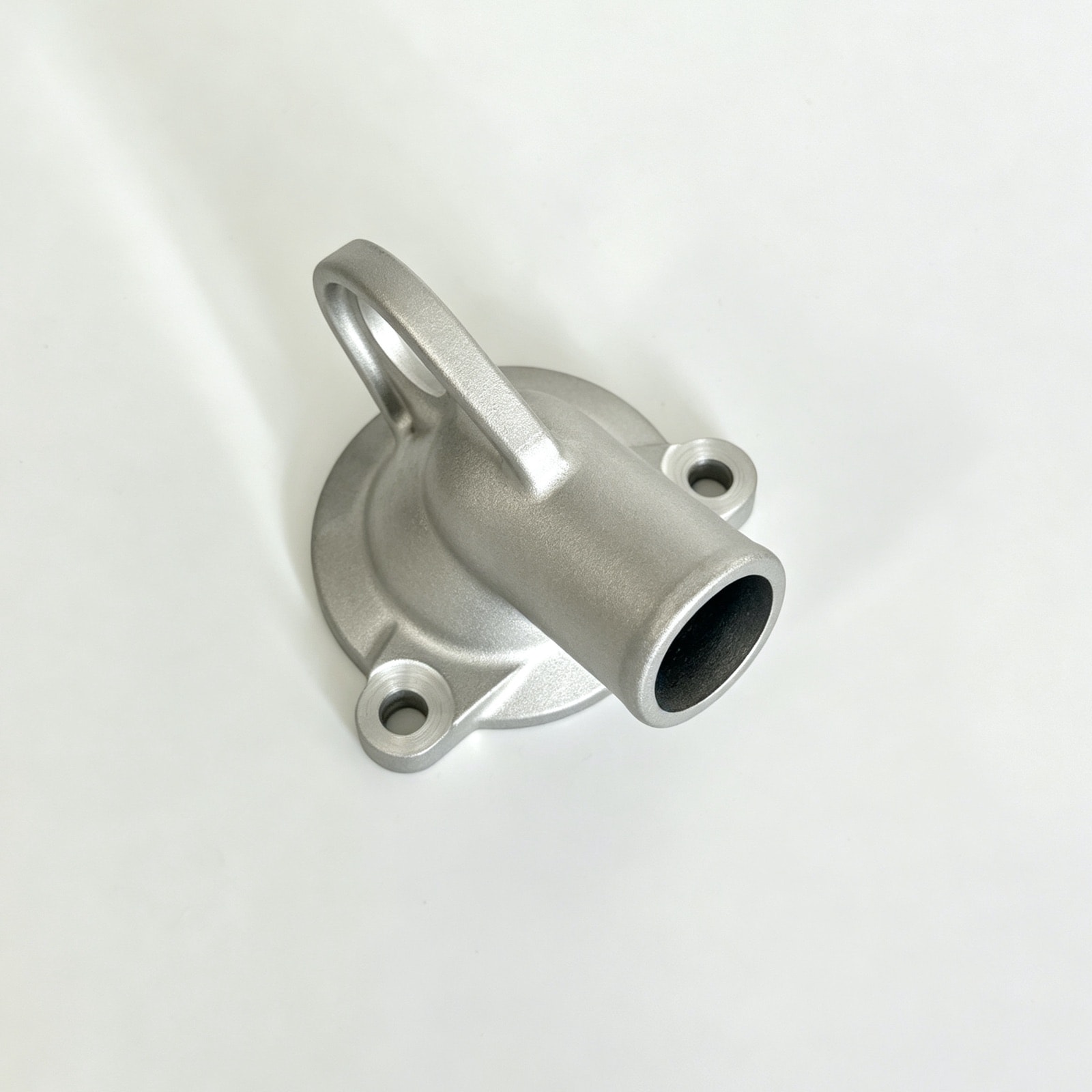
Die-Cast Engine Thermostat Housing: Under 0.02 mm Flatness Change After Thermal Cycling
Thermal cycling moved the sealing face and coolant attacked porosity. Stress relief, impurity control and 100% leak testing keep field leaks under 0.1%.
Part data
| Part name | Engine Thermostat Housing |
|---|---|
| Part type | Pump bodies & sealed housings |
| Application | Engine cooling system thermostat seat |
| Customer type | Tier-1 supplier |
| Alloy | ADC12 (JIS H5302) |
| Envelope | 约 95 × 80 × 65 mm |
| Part weight | 约 230 g |
| Wall thickness | 3.0 – 4.5 mm |
| Key requirements | Sealing-face flatness, pressure tightness, coolant corrosion resistance |
| Machining | Sealing face milled, outlet machined, drilled and tapped |
| Surface finish | Shot blasting |
| Delivered as | Machined part |
| In production since | 2023 |
* Figures shown are representative; actual values follow the drawing and DFM review.
Updated
Technical requirements
Sealing
The housing carries cooling-system pressure and is leak tested at 0.25 MPa held for 30 s, with no leakage allowed.
Geometric tolerances
The sealing face must be flat within 0.05 mm and stay that way after thermal cycling.
Material
Every batch of alloy is checked by spectrometer with iron content controlled, because aluminum's corrosion resistance in coolant depends on iron and other impurities.
Engineering challenges
Sealing-face creep under thermal cycling
After thermal-cycle testing on the bench the sealing face has moved and the joint weeps. Residual casting stress relaxes over repeated heating cycles, leaving a permanent dimensional change — worst on parts that were never stress-relieved.
Corrosion-driven leakage in coolant
Over time corrosion propagates from porosity and opens a leak path. Aluminum's resistance in coolant depends on iron and other impurities; once porosity connects to the outside, coolant gets in and accelerates the attack.
What we did
Stress relief before machining (blank processing)
Residual casting stress relaxes over repeated heating cycles and leaves a permanent change in the sealing face. We stress-relieve the blanks before machining and sample the flatness change after thermal-cycle testing.
Spectrometer analysis of every batch to control impurities (incoming material and melting)
Impurities above the limits weaken resistance to coolant, so every batch of alloy is checked by spectrometer; reports are archived and can ship with the goods on request.
High-pressure casting with optimised gating to reduce internal porosity (casting process)
Once internal porosity connects to the outside, coolant gets in and accelerates corrosion into a leak path. We reduce internal porosity by optimising gating and venting; parts are X-ray sampled and every housing is leak tested.
Results in stable production
In stable production more than 99% pass the leak test first time, flatness changes by no more than 0.02 mm after thermal cycling, and weeping complaints in service are below 0.1%.
Questions on this part
Why control iron content on a cooling-system part?+
Iron in ADC12 is a double-edged thing: around 0.7–1.1% prevents die soldering, but too much forms needle-like iron-rich phases that cut toughness and act as corrosion initiation sites. In coolant those phases couple galvanically with the aluminum matrix and accelerate local attack, which over time can grow from a pore into a leak path. So for cooling-system parts we run spectrometer analysis on every batch with a cap on iron, and the reports ship with the goods.
Do pressure parts need a stress-relief step?+
If the part sees repeated thermal cycling, yes. Castings hold residual stress that relaxes over those cycles into a permanent dimensional change — typically showing up as a sealing face that has moved after bench testing and started to weep. The usual treatment is 180–200 ℃ for 2–3 hours before machining so the movement happens first. Natural ageing over several weeks does something similar for less critical parts, but you cannot schedule it.
Related cases
Capabilities and further reading
Have a part like this?
Start with the cost estimator to see how the price is built, or upload a drawing for us to review — we reply within 24 hours.