CASE STUDIES · Pumps, Valves & Fluid Components
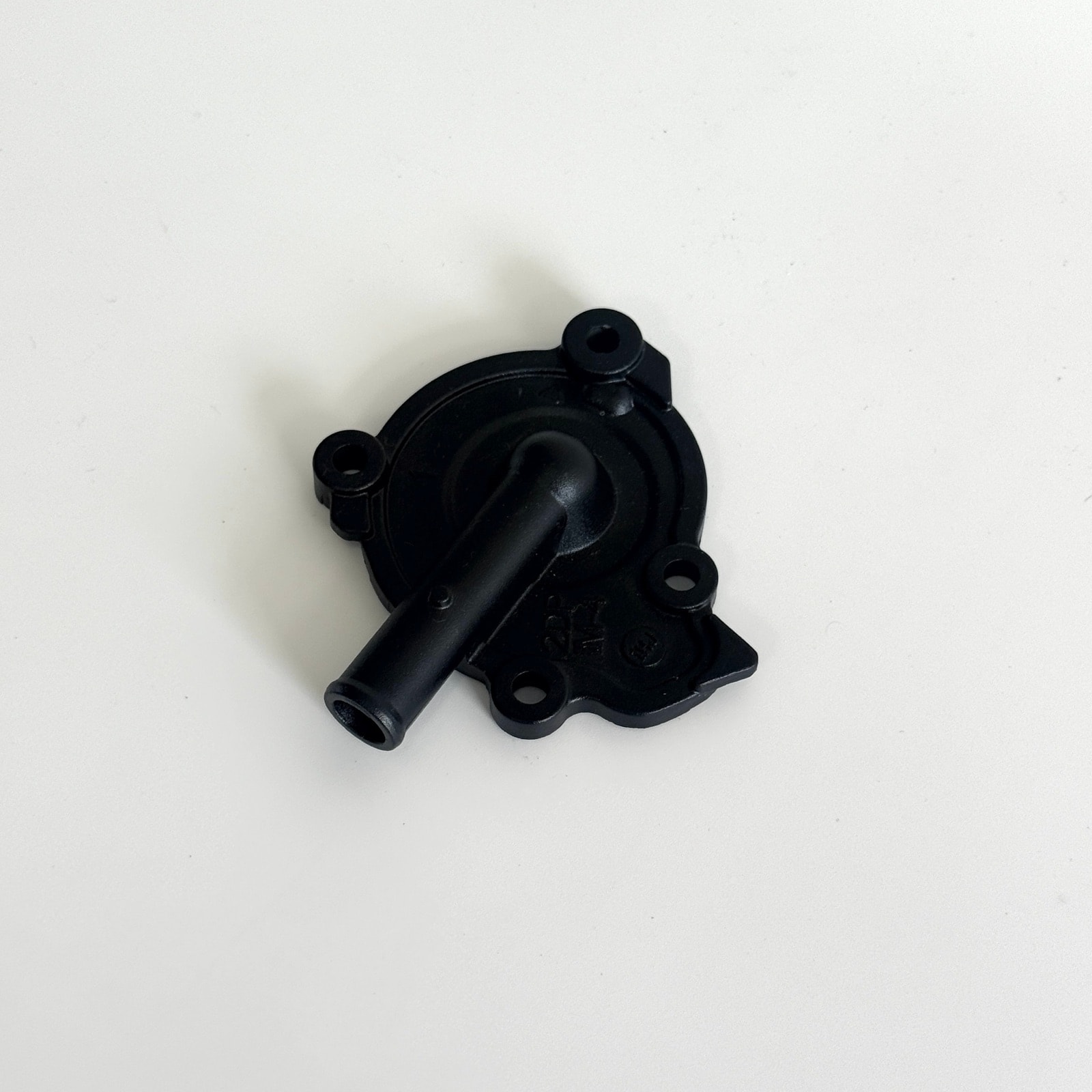
Die-Cast Engine Water Pump Cover: Sound Spigot Root, 99% First-Pass Leak Yield
Shrinkage at the outlet-spigot root caused leaks. A graded root radius, local squeeze and leak testing before coating now give 99% first-pass yield.
Part data
| Part name | Engine Water Pump Cover |
|---|---|
| Part type | Pump bodies & sealed housings |
| Application | Cooling pump assembly |
| Customer type | OEM and aftermarket |
| Alloy | ADC12 (JIS H5302) |
| Envelope | 约 100 × 90 × 55 mm |
| Part weight | 约 210 g |
| Wall thickness | 2.5 – 4.0 mm |
| Key requirements | Joint-face flatness, spigot tightness, coating appearance |
| Machining | Joint face milled, mounting holes drilled |
| Surface finish | Blasting + black coating |
| Delivered as | Finished part |
| In production since | 2023 |
* Figures shown are representative; actual values follow the drawing and DFM review.
Updated
Technical requirements
Geometric tolerances
The joint face must be flat within 0.05 mm so the gasket is compressed evenly against the pump body.
Sealing
The whole cover is leak tested at 0.25 MPa held for 30 s, with no leakage allowed.
Internal soundness
No through-shrinkage is allowed at the outlet-spigot root, checked by X-ray sampling.
Engineering challenges
Shrinkage at the outlet-spigot root
X-ray shows shrinkage where the spigot meets the body, and that is where the leak test fails. Where a cylindrical spigot meets a flat cover the effective section is far thicker than either side — a textbook hot spot that freezes last with nothing feeding it.
What we did
Spigot root opened into a graded radius and cored out where possible (DFM review)
Where a cylindrical spigot meets a flat cover the effective section is far thicker than either side, so it freezes last with nothing feeding it. At DFM we opened the root into a graded radius and cored it out where possible; simulation confirms the hot spot and the root is X-ray sampled.
Local squeeze feeding near the root (casting process)
Even after the redesign, the root is still the heaviest section, so a local squeeze pin compacts the last metal to freeze. Sectioned parts confirm soundness, and every cover is leak tested.
Every cover leak tested before coating (in-process inspection)
A leaking cover that reaches the coating line is scrapped with the coating cost on top. We leak test every cover before coating, tag any that leak and section them for analysis, feeding the result back to the casting process.
Results in stable production
In stable production 99% pass the leak test first time, coating rework is below 0.5%, and joint-face flatness is no more than 0.05 mm.
Questions on this part
Why leak test before coating rather than after?+
Two reasons. Cost: a leaker scrapped after coating has wasted a whole finishing operation. And accuracy: coating can temporarily plug a micro-leak, so a post-coating test passes parts that fail later at the customer. We test 100% before coating to catch failures, then sample after coating to confirm the finishing step did not introduce anything new.
Can a part that fails the leak test be repaired?+
Micro-leaks can be sealed by vacuum impregnation, with every impregnated part re-tested. But impregnation is a safety net, not a routine step: if the impregnation rate keeps climbing, the casting process has drifted and the answer is die temperature, venting and feeding — not more impregnation. Through-shrinkage or cracks cannot be impregnated and the part is scrap.
Related cases
Capabilities and further reading
Have a part like this?
Start with the cost estimator to see how the price is built, or upload a drawing for us to review — we reply within 24 hours.