CASE STUDIES · Pumps, Valves & Fluid Components
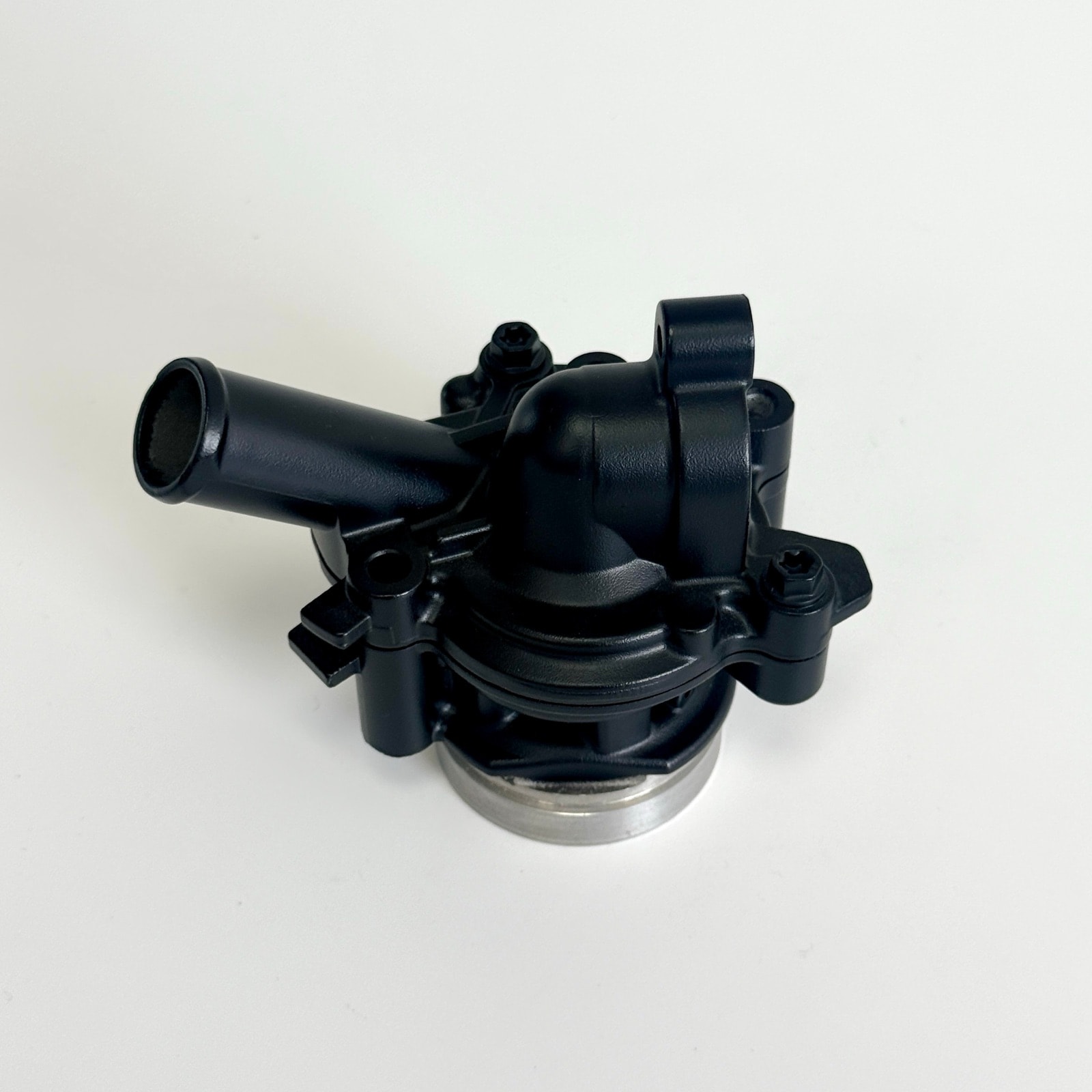
Cooling Water Pump Assembly, Cast to Finished Unit In-House: Zero Incoming Rejects at the Customer
One supplier from casting to finished pump. Leak tests before and after press-fitting, masked fits and monitored press force took incoming rejects to zero.
Part data
| Part name | Cooling Water Pump Assembly for Motorcycles and Small Engines |
|---|---|
| Part type | Pump bodies & sealed housings |
| Application | Cooling pump assembly for motorcycles and GP engines |
| Customer type | OEMs and export customers |
| Alloy | ADC12 (JIS H5302) |
| Envelope | 约 120 × 95 × 85 mm(总成) |
| Part weight | 约 480 g(总成) |
| Wall thickness | 2.5 – 4.5 mm |
| Key requirements | Assembly tightness, free rotation without binding, coating adhesion |
| Machining | Seal seat and bearing bore bored, joint face milled, drilled and tapped |
| Surface finish | Blasting + black coating |
| Delivered as | Finished assembly with seal, bearing and shaft |
| In production since | 2024 |
* Figures shown are representative; actual values follow the drawing and DFM review.
Updated
Technical requirements
Sealing
The assembly is leak tested at 0.25 MPa held for 30 s, with no leakage allowed.
Function
Rotation torque and axial play are accepted to the customer's specification, and every assembly is checked.
Coating
The black coating must rate 4B or better on the cross-hatch test, at 20–40 μm film thickness.
Engineering challenges
Press-fitting changes the sealing condition
The housing passes on its own, then the assembly leaks once seal and bearing are pressed in. Press-fit stress can open micro-porosity, or distort the seat slightly so the seal lip no longer beds evenly.
Coating creeping onto fitting surfaces
Coating reaches the bearing seat and seal bore; the interference changes on assembly and the shaft binds. A 20–40 μm film is not negligible against an H7 fit; if masking is imperfect it changes the interference directly.
What we did
Housing and assembly leak tested separately (after machining and after assembly)
A housing can pass on its own and still leak once the seal and bearing are pressed in, because press-fit stress opens micro-porosity or distorts the seat. On this project we leak test after machining and again after assembly, and compare the two to find where a leak started.
Fitting surfaces masked with dedicated tooling before coating (finishing)
A 20–40 μm film is not negligible against an H7 fit; coating that reaches the bearing seat or seal bore changes the interference and makes the shaft bind. We mask the fits with dedicated tooling and check every part for coating on them afterwards.
Press force and depth monitored in line (assembly)
Press force and depth are monitored in real time, with an alarm outside the window; press curves are archived and every assembly is torque-checked for free rotation.
Results in stable production
In stable production more than 98% of assemblies pass the leak test first time and incoming rejects at the customer have dropped to zero. Every assembly is rotation-checked, and none that binds is released.
Questions on this part
Why does a housing that passed leak once it is assembled?+
Press-fitting is a step that can change the seal. Two common mechanisms: the press stress opens micro-porosity that was closed, or the seat distorts slightly under the interference so the seal lip no longer beds evenly. To tell: leak test the housing alone and again as an assembly and compare. Pass then fail means the press operation is the culprit, and you go back to interference, press force and seat roundness.
How does responsibility differ between a finished assembly and a machined part?+
With a finished assembly we own incoming inspection of the bought-out parts (seal, bearing, shaft), the assembly work and the functional test — you receive something that goes straight to your line. With a machined part we are responsible for the casting and the machined dimensions only; components and assembly are yours. Finishing is ours even when subcontracted, as long as we coordinate it; if you nominate your own finisher, the split of responsibility gets written into the contract separately.
Related cases
Capabilities and further reading
Have a part like this?
Start with the cost estimator to see how the price is built, or upload a drawing for us to review — we reply within 24 hours.